We have compiled a list of manufacturers, distributors, product information, reference prices, and rankings for Management education video.
ipros is IPROS GMS IPROS One of the largest technical database sites in Japan that collects information on.

Management education video - List of Manufacturers, Suppliers, Companies and Products

Management education video Product List

1~9 item / All 9 items

Displayed results

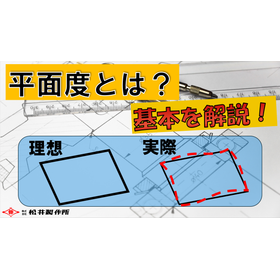
What is flatness for automotive parts inspection? A 5-minute explanation.

Video materials useful for quality control of automotive parts.

In the automotive industry, understanding geometric tolerances is essential to ensure the quality and safety of products during parts inspection. In particular, flatness greatly affects the precise assembly and functionality of components. Deficiencies in flatness can lead to malfunctions or performance degradation of parts. This video explains the basics of "flatness," which is a type of geometric tolerance. 【Application Scenarios】 * Verification of flatness in parts inspection * Acquisition of basic knowledge for interpreting drawings * Training for quality control personnel 【Effects of Implementation】 * Improved accuracy in parts inspection * Reduction of defective products * Enhanced quality management capabilities

Added to bookmarks

Bookmarks list

Bookmark has been removed

Bookmarks list

You can't add any more bookmarks

By registering as a member, you can increase the number of bookmarks you can save and organize them with labels.

Free membership registration

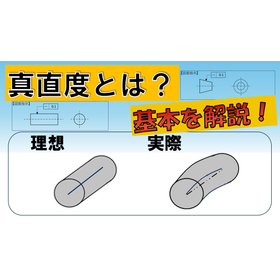
Geometric Tolerance for Semiconductor Manufacturing: What is Straightness?

Explaining the basics of straightness in semiconductor manufacturing!

In the semiconductor manufacturing industry, high precision is required. The flatness and shape accuracy of related components are directly linked to the performance of semiconductor devices, making the understanding of straightness important. Knowing the definition of straightness and how it is used in drawings can aid in quality management during the manufacturing process. This video explains the basics of straightness and supports problem-solving in semiconductor manufacturing. 【Usage Scenarios】 - Precision management of semiconductor manufacturing equipment parts - Training for quality control personnel 【Benefits of Implementation】 - Deepening the understanding of straightness and improving quality management capabilities - Enhancing drawing interpretation skills - Reducing the rate of defective products

Added to bookmarks

Bookmarks list

Bookmark has been removed

Bookmarks list

You can't add any more bookmarks

By registering as a member, you can increase the number of bookmarks you can save and organize them with labels.

Free membership registration

Basic Geometric Tolerances for 3D Printing: Right Angle

To improve the accuracy of 3D printer creations!

In the 3D printing industry, the accuracy of the printed objects greatly affects the quality of the products. Particularly in additive manufacturing, precise alignment of each layer is crucial, and understanding perpendicularity is essential. If perpendicularity is not properly managed, dimensional errors and distortions in the printed objects may occur, potentially adversely affecting the functionality and appearance of the products. This video explains the basics of "perpendicularity," a type of geometric tolerance. It covers the definition of perpendicularity, how it is used in drawings, and points to consider when using it, supporting problem-solving in 3D printer manufacturing. 【Application Scenarios】 - When producing prototypes with a 3D printer - Manufacturing parts that require high precision in printed objects - When defects occur that differ from the design drawings 【Benefits of Implementation】 - Improvement in the quality of printed objects - Achieving prints as per the design - Reduction of defective products

Added to bookmarks

Bookmarks list

Bookmark has been removed

Bookmarks list

You can't add any more bookmarks

By registering as a member, you can increase the number of bookmarks you can save and organize them with labels.

Free membership registration

Reduce defects with a cause-and-effect diagram for the manufacturing industry!

Explaining the basics of the cause-and-effect diagram! This is a video resource that helps in reducing defects.

In the manufacturing industry, the occurrence of defective products is a significant challenge that leads to increased costs and a loss of trust from customers. To reduce defects, it is essential to identify the root causes of the problems and implement countermeasures. This video explains how to create a cause-and-effect diagram (fishbone diagram), which is fundamental to quality management. The cause-and-effect diagram is a powerful tool for systematically analyzing the causes of problems and developing effective countermeasures. This video material will serve as the first step in problem-solving for those in the manufacturing industry aiming to reduce defects. 【Usage Scenarios】 * Analyzing the causes of defects in the manufacturing site * Improving the quality management system * Enhancing problem-solving capabilities 【Effects of Implementation】 * Reducing the defect occurrence rate * Streamlining quality management * Improving problem-solving abilities

Added to bookmarks

Bookmarks list

Bookmark has been removed

Bookmarks list

You can't add any more bookmarks

By registering as a member, you can increase the number of bookmarks you can save and organize them with labels.

Free membership registration

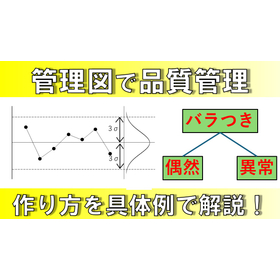
Explaining the basics of management charts for energy facilities!

Explaining the basics of control charts with examples! Useful for quality management in equipment maintenance.

In the energy equipment industry, stable operation of equipment is crucial for maintenance. Therefore, it is necessary to grasp daily inspection data and abnormal values to detect equipment anomalies early. Control charts help visualize the operational status of equipment and assist in the early detection of signs of abnormalities. This video explains the basics of control charts and supports the improvement of quality management in equipment maintenance. 【Usage Scenarios】 - Monitoring equipment operational status - Early detection of abnormal values - Improvement of quality management 【Effects of Implementation】 - Maintenance of stable equipment operation - Reduction of failure risks - Enhancement of quality management capabilities

Added to bookmarks

Bookmarks list

Bookmark has been removed

Bookmarks list

You can't add any more bookmarks

By registering as a member, you can increase the number of bookmarks you can save and organize them with labels.

Free membership registration

What are the successful cases that resolved the issue of "unstable quality" through video training?

[Manufacturing Industry New Employee Training] [Video Training] Introducing the causes of quality instability, key points for quality stabilization, and a checklist!

In the manufacturing industry, stabilizing quality is one of the most important challenges. If quality remains unstable, the risk of increased product defects, complaints, and recalls rises, which can damage the company's reputation. The main causes of unstable quality include the following points: - Work procedures are not standardized, leading to variations among workers. - There is a significant difference in skill levels between new and less experienced workers. - Understanding of quality standards is insufficient, and appropriate checks are not being conducted. - Procedures for responding to defects are not thoroughly implemented. To address these issues, many companies are introducing quality management training utilizing video training to achieve quality stabilization. *For more details, please feel free to contact us.*

  • Distance learning/E-learning
  • Distance learning/E-learning

Added to bookmarks

Bookmarks list

Bookmark has been removed

Bookmarks list

You can't add any more bookmarks

By registering as a member, you can increase the number of bookmarks you can save and organize them with labels.

Free membership registration

Why newcomers fail to notice abnormalities in filling amounts | Techniques for reviewing inspection line training

[Manufacturing Industry New Employee Training] [Video Training] Cultivating Observation Skills to Improve Quality and Safety

"I thought I had checked properly myself." "It was a small difference, so I didn't notice it." From the words of such a newcomer, isn't the issue of the inspection line's "inability to notice abnormalities" becoming apparent? ● An abnormal filling amount (too little or too much) cannot be judged just by looking. ● Although they are "checking," they do not see the "difference from the standard." ● Even the instructors are teaching by "learning by watching," leading to a vague understanding of the standards. This is a sign of insufficient training due to "looking without knowing the points of inspection." Checking the filling amount is not just a matter of visual observation; it is a "judgment skill." To cultivate that skill, education designed from the perspective of newcomers that focuses on "what to look at" and "how to judge" is essential. At LinkStudio, we produce numerous comparative and visual video materials specialized in visualizing inspection points, judgment discrepancies, and quality abnormalities. We invite you to consider video education to transform the workplace from "not understanding by looking" to "understanding by looking." *For more details, please feel free to contact us.

  • Distance learning/E-learning

Added to bookmarks

Bookmarks list

Bookmark has been removed

Bookmarks list

You can't add any more bookmarks

By registering as a member, you can increase the number of bookmarks you can save and organize them with labels.

Free membership registration

What are the subtle quality defects caused by a newcomer over-tightening screws?

[Manufacturing Industry New Employee Training] [Video Training] Education to Prevent Over-tightening Protects Quality and Productivity

"I thought I tightened the screws properly, but the material cracked." "I tightened it too much, and the surface got dented." Are you seeing more reports like this from new workers on the job site? ● Cracking and denting of materials due to over-tightening screws ● Deformation and assembly defects caused by excessive tightening ● Ambiguous guidance on tightening leads to frequent quality issues This is due to a lack of education that clearly teaches the "appropriate tightening of screws." Over-tightening screws is a major cause of quality defects. That’s why it’s essential to provide clear education on proper tightening. At LinkStudio, we have produced numerous video materials focused on visualizing tightening techniques. Would you like to implement education through videos that prevents "over-tightening" and protects quality and productivity? *For more details, please feel free to contact us.

  • Distance learning/E-learning

Added to bookmarks

Bookmarks list

Bookmark has been removed

Bookmarks list

You can't add any more bookmarks

By registering as a member, you can increase the number of bookmarks you can save and organize them with labels.

Free membership registration

How do you convey that "cutting corners doubles the defect rate"?

[Manufacturing Industry New Employee Training] The Importance of Slag Cleaning and Challenges in New Employee Education! Achieving Thorough Slag Cleaning and Quality Improvement through Enhanced Training.

In the casting site, the removal of slag (impurities) is a crucial process that affects product quality. However, there have been reports of increased defect rates due to new workers not fully understanding the importance of this process and cutting corners. Such situations can lead to problems such as a decline in product quality, an increase in rework, and delays in delivery, which negatively impact the overall productivity of the company. The main reasons why new workers underestimate slag cleaning are as follows: ● Lack of understanding of the importance of the process: They do not recognize the impact of slag cleaning on product quality. ● Ambiguity in work procedures: Specific cleaning procedures and standards are not clearly defined. ● Issues with the education method: Instruction is mainly based on experience, without conveying the theoretical background or specific impacts. Slag cleaning is essential for ensuring quality in the casting process. Through appropriate education and training, we can enhance workers' awareness and skills, leading to improved product quality and productivity. *For more details, please feel free to contact us.

  • Distance learning/E-learning

Added to bookmarks

Bookmarks list

Bookmark has been removed

Bookmarks list

You can't add any more bookmarks

By registering as a member, you can increase the number of bookmarks you can save and organize them with labels.

Free membership registration